As technology companies build enormous facilities to power artificial intelligence, American households face a troubling question: Who should pay for the electricity and infrastructure these machines require?
Your electricity bill arrives, and the amount is higher than you expected. You check the thermostat, think about how often you used the air conditioner, and wonder whether someone left the lights on.
But part of the explanation may have nothing to do with what happened inside your home.
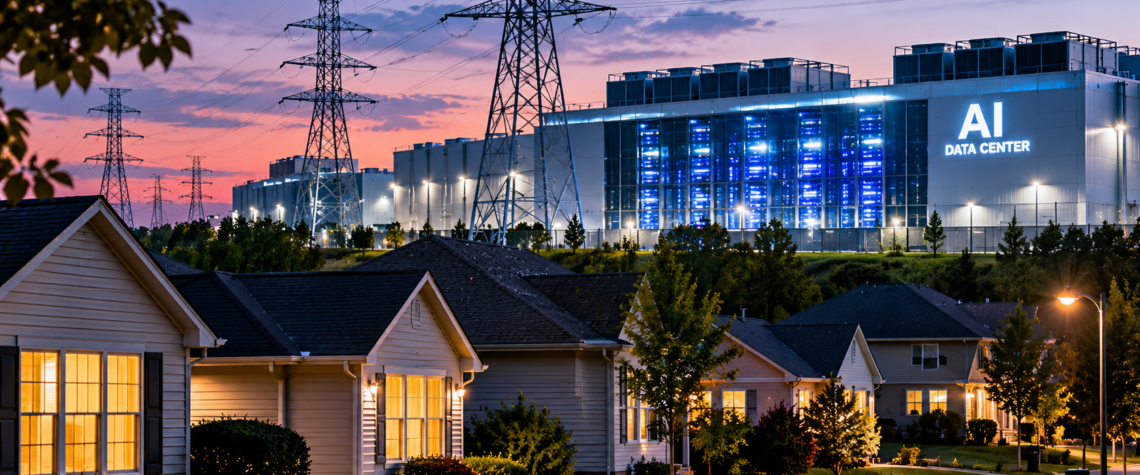
Across the United States, technology companies are building enormous data centers to power artificial intelligence, cloud computing, and other digital services. These facilities require extraordinary amounts of electricity, and the infrastructure needed to serve them can be expensive.
As utilities expand their networks to accommodate this demand, consumer advocates are asking whether ordinary households are being required to shoulder some of the costs.
A series of investigations by Consumer Reports has brought new attention to the issue, revealing growing concern about electricity affordability and the rapid expansion of AI infrastructure.
The question is no longer simply how much energy artificial intelligence consumes. It is who ultimately pays for it.
The Buildings Behind Artificial Intelligence
When someone asks an AI chatbot a question, the response appears almost instantly. What remains invisible is the enormous physical infrastructure behind that seemingly effortless interaction.
AI systems run on specialized computers housed in data centers. These machines perform vast numbers of calculations, while cooling equipment keeps the hardware from overheating.
Traditional data centers have supported the internet for decades. But the growing use of generative AI has accelerated demand for powerful processors and much larger facilities.
Some new hyperscale data centers consume as much electricity as a small city.
According to an updated Department of Energy analysis, American data centers consumed approximately 4.7% of the nation’s electricity in 2024. Depending on how rapidly the industry expands, that share could reach between 9.5% and 15.3% by 2030.
These are projections, not guaranteed outcomes. Construction delays, improvements in computing efficiency, and changes in AI demand could alter the figures considerably.
Nevertheless, the potential growth presents a major challenge for the nation’s electrical system.
Why Your Bill Could Increase
Electricity is not delivered directly from a power plant to a single home. It travels through an interconnected network of generating facilities, transmission lines, substations, and local distribution equipment.
When a major data center requires large amounts of electricity, a utility may need to invest in new infrastructure.
Those investments can include transmission lines, substations, transformers, generating capacity, and other equipment.
The central financial question is how those costs are divided.
If a utility is allowed to recover some of its investment through rates charged to all customers, residential households may end up paying part of the expense, even if the new infrastructure was built primarily to serve a large commercial customer.
The effect is not uniform across the country. Electricity markets, utility regulations, existing infrastructure, and the terms of individual data-center agreements all influence who pays.
In a June 2026 study revised in October, researchers at the Massachusetts Institute of Technology examined data-center development and electricity rates between 2010 and 2024. They found that data-center entry was associated with an average increase of 2.7% in retail electricity rates and 2.1% in residential rates, with larger effects among investor-owned utilities.
Those findings suggest that data centers can raise costs for households. They do not mean that every American’s electricity bill has increased by those percentages because of AI.
The Consumer Reports Warning
Consumer Reports has documented how the expansion of data centers is colliding with an existing affordability crisis.
In a July 2026 investigation, the organization reported that roughly one in six American households was behind on utility payments.
It also highlighted the financial pressure created by proposed utility rate increases and the growing demand for electricity from large technology facilities.
In October, Consumer Reports launched its Power Smarter initiative to help households understand their bills and participate in debates over utility rates.
A nationally representative survey of 2,003 American adults found that 38% identified increased electricity demand from data centers and AI systems as a factor they believed was affecting their electricity costs.
That finding measures public perception, not the precise contribution of data centers to each household’s bill. But the concern is significant.
The same survey found that 84% of Americans supported creating a separate electricity-rate category for large customers such as data centers.
The underlying idea is straightforward: companies creating exceptional demand for electricity should pay an appropriate share of the infrastructure costs associated with that demand.
Not Every Increase Is Caused by AI
There is an important qualification.
Electricity prices were already rising for several reasons before the latest wave of AI investment.
Utilities are replacing aging infrastructure, upgrading equipment to withstand extreme weather, and facing higher construction and financing costs. Natural gas prices, fuel expenses, and seasonal demand also influence what consumers pay.
The U.S. Energy Information Administration’s October 2026 forecast estimated that the average residential electricity price would rise from 17.3 cents per kilowatt-hour in 2025 to 18.2 cents in 2026.
Those increases cannot be attributed entirely to data centers.
A recent FactCheck.org examination found that the national evidence remains mixed. Some studies suggest that data centers have already contributed to higher rates, while others find that the effect has been limited or depends heavily on local conditions.
One important exception is the PJM electricity market, which serves parts of the Mid-Atlantic and Midwest. Rapid demand growth, including from data centers, has contributed to higher costs in that regional market.
The most accurate conclusion is that AI infrastructure is an emerging source of financial pressure, particularly in certain regions, rather than the sole explanation for rising electricity bills nationwide.
Could Technology Companies Pay Their Own Way?
The technology industry argues that data centers create jobs, attract investment, and support economic growth.
Large facilities can also become major electricity customers, potentially helping utilities spread some fixed operating costs over a larger customer base. But these benefits depend on how projects are planned and financed.
If a data center requires expensive infrastructure that is later underused, residential customers could be exposed to financial risks.
Consumer advocates have proposed requiring large technology customers to pay directly for infrastructure constructed primarily for their facilities.
Other approaches include long-term electricity contracts, minimum payment commitments, and special utility rates for exceptionally large users.
Some technology companies have publicly committed to reducing the impact of their projects on household electricity bills.
The challenge is ensuring that such promises are reflected in enforceable agreements rather than public-relations statements.
For consumers, the important question is not whether technology companies should build data centers. It is whether the financial arrangements are fair.
How to Understand Your Electricity Bill
Consumers cannot control the construction of data centers, but they can take steps to understand what is happening to their electricity costs.
Start by comparing electricity usage, not just the total amount owed. Your bill generally shows consumption in kilowatt-hours. If your usage has remained relatively stable while the amount charged has increased, higher rates or fees may be contributing to the difference.
Look for changes in the price per kilowatt-hour, delivery charges, and other fees. The exact terminology varies by utility.
Compare bills from the same season in previous years, because heating and cooling needs can create large fluctuations.
Many utilities also provide online tools showing daily or hourly electricity consumption. These can help identify whether the increase is related to household usage.
If your bill is unusually high, contact the utility and request an explanation of recent rate changes.
Consumers can also follow proceedings before their state public utility commission, the agency that typically reviews proposed increases for regulated utilities.
These proceedings may include opportunities for public comments and hearings.
For households struggling with payments, state energy-assistance programs and utility payment arrangements may provide additional support.
A Question That Goes Beyond Electricity
Artificial intelligence promises to make many aspects of modern life more efficient. It may improve medical research, education, transportation, and energy management itself.
But those benefits depend on physical resources that are neither unlimited nor free.
Behind every AI-generated answer is a network of machines consuming electricity, occupying land, and requiring investment in infrastructure.
As that network expands, Americans will increasingly confront questions that once seemed distant from the digital world.
Who decides where the facilities are built? Who pays for the additional electricity infrastructure? And who bears the financial risk if projected demand never materializes?
These are not merely technical questions. They are questions about consumer protection, corporate responsibility, and the future cost of living.
Artificial intelligence may be transforming the digital economy, but its costs are becoming very real in the physical world. And consumers deserve to know whether those costs are appearing on their electricity bills.
Sources:
Consumer Reports: AI Data Centers’ Impact on Electric Bills, Water, and More — March 2026.
Consumer Reports: Power Smarter Initiative — October 21, 2026.
MIT: Who Pays for Growth? Evidence from Data Centers and the Grid — revised October 2026.
US Energy Information Administration: October 2026 Electricity Outlook.
FactCheck.org: Data Centers and Electricity Prices — October 29, 2026.